Most people who launch an online store focus on the exciting part: picking products, designing a logo, and dreaming about sales. Then the bills arrive, and reality hits hard.
E-commerce business startup costs are almost always higher than new entrepreneurs expect. Not because the industry is deceptive, but because the cost structure is layered. Some costs are obvious. Many are not.
This guide breaks down every major and hidden expense you will face when building an online store. Whether you are starting from scratch or trying to understand why your margins are shrinking, this breakdown gives you the full picture.
Quick Answer
What are the typical e-commerce business startup costs?
Most new e-commerce stores spend between $1,000 and $10,000 to launch, depending on scale and model. Ongoing monthly operating expenses typically range from $500 to $5,000+. Core cost categories include: platform fees, domain and hosting, inventory, payment processing, marketing, fulfillment, and customer service tools.
Table of Contents
- Why Understanding Your Cost Structure Matters
- One-Time Setup Costs
- Monthly Online Store Operating Expenses
- Inventory Procurement Costs
- E-commerce Platform Pricing Comparison
- Digital Marketing Budget for E-commerce
- Payment Gateway Transaction Fees
- Warehousing and Fulfillment Costs
- Hidden Costs of Running an Online Store
- E-commerce Cost Breakdown Template
- Real-World Budget Examples
- FAQ
1. Why Understanding Your Cost Structure Matters
Running an e-commerce store is a business, not just a website. Businesses have cost structures, and if you do not map yours out before you spend a single dollar, you are making financial decisions blind.
Understanding your costs lets you:
- Set prices that actually generate profit
- Identify which expenses are eating into your margins
- Plan how much capital you need before becoming profitable
- Make smarter decisions about where to cut or invest
Most failed online stores did not fail because of bad products. They failed because the numbers never worked, and the owner did not realize it until too late.
2. One-Time Setup Costs
These are costs you pay at launch. Some are small. Some are significant. All of them are necessary.

If you are using a platform like Shopify or WooCommerce with a pre-built theme, you can launch a basic store for under $500. A custom-built, branded store with professional photography can easily cost $5,000 or more before you sell a single product.
3. Monthly Online Store Operating Expenses
Once you are live, the monthly costs begin. These are your online store operating expenses, and they recur whether you make sales or not.
Core monthly expenses include:
- E-commerce platform subscription: $29–$299/month
- Domain renewal (prorated): $1–2/month
- Email marketing software: $15–$100/month
- Customer service tools (live chat, helpdesk): $20–$80/month
- Accounting software: $15–$50/month
- Apps and plugins: $30–$200/month
- Security and SSL certificate: $0–$30/month (often included in platform plans)
A realistic baseline for monthly operating expenses on a small store is $200 to $600/month, before marketing or inventory.
4. Inventory Procurement Costs
Inventory procurement costs are one of the largest and most variable expenses in e-commerce. How much you spend depends entirely on your sourcing model.
Common sourcing models and their cost implications:
Wholesale buying: You purchase products in bulk at discounted rates. Minimum order quantities (MOQs) typically range from $300 to $2,000 per product. You get better margins but higher upfront risk.
Dropshipping: You pay no upfront inventory cost. Products ship directly from the supplier to your customer. Margins are thin (typically 15–30%), but capital requirements are minimal.
Private label manufacturing: You source a generic product and brand it as your own. Minimum orders are usually 200–500 units. Startup costs range from $1,000 to $5,000 per product, but you own the brand equity.
Print-on-demand: Similar to dropshipping. No upfront inventory. Products are made when ordered. Margins are slim but risk is low.
Key procurement costs to account for:
- Unit cost of goods
- Shipping from supplier to your warehouse
- Import duties and customs (for international sourcing)
- Quality inspection fees
- Packaging and labeling
A commonly missed rule: your landed cost (what the product actually costs to get to your warehouse) is often 20–40% higher than the quoted unit price from a supplier.
5. E-commerce Platform Pricing Comparison
Your platform choice is one of the most consequential early decisions you make. Here is a side-by-side e-commerce platform pricing comparison:
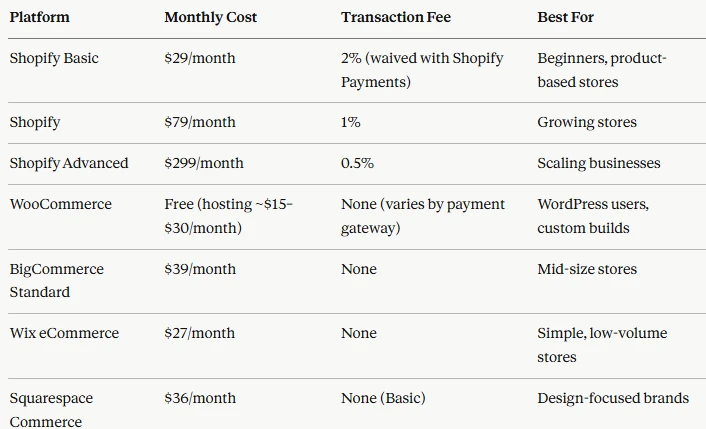
The hidden cost of "free" platforms like WooCommerce: You will pay for hosting, security, premium plugins, and likely a developer at some point. The total cost of ownership is often similar to Shopify.
For most beginners, Shopify Basic at $29/month is the smartest starting point because of its reliability, app ecosystem, and built-in payment processing.
6. Digital Marketing Budget for E-commerce
You can build the most beautiful store in the world, but without traffic, it generates zero revenue. Your digital marketing budget for e-commerce is not optional; it is fuel.
Common digital marketing channels and estimated monthly costs
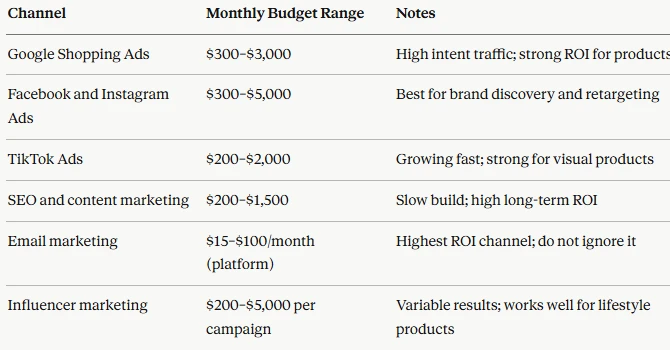
A realistic beginner marketing budget: $500 to $1,500 per month to start testing. Many new stores underspend on marketing and then blame the product for poor sales.
A general rule used by e-commerce operators: allocate 10–20% of your target monthly revenue to marketing. If you want $10,000 in monthly revenue, budget $1,000 to $2,000 for ads and content.
7. Payment Gateway Transaction Fees
Every time a customer pays you, someone takes a cut. Payment gateway transaction fees are a cost that quietly erodes your margins if you do not account for them.
What this means in practice: On a $50 product sale, you pay approximately $1.75 in payment processing fees. On $10,000 in monthly revenue, that is roughly $320 in fees. On $100,000 in revenue, it becomes $3,200 per month.
This is why Shopify Payments is attractive for Shopify users: it eliminates the additional transaction fee that Shopify charges when you use a third-party gateway.
8. Warehousing and Fulfillment Costs
Once you make a sale, you need to store, pack, and ship the product. Warehousing and fulfillment costs are among the most complex parts of the cost structure.
Three main models:
Self-fulfillment (shipping from home or a rented space):
- Lowest cost to start
- Your time is the hidden expense
- Works well under 50–100 orders per month
Third-party logistics (3PL):
- You send inventory to a 3PL warehouse; they pick, pack, and ship for you
- Typical costs: $1–$3 per unit for receiving, $0.50–$1.50/month per unit for storage, $3–$8 per order for fulfillment
- Scales well; frees up your time
Fulfillment by Amazon (FBA):
- Amazon stores and ships your products
- Works if you sell on Amazon
- Fees vary widely by product size and weight; typically $3–$6+ per unit fulfilled
9. Hidden Costs of Running an Online Store
These are the costs no one puts in the launch budget. They are real, and they add up.
Returns and refunds: E-commerce return rates average 20–30% for apparel and 8–15% for general merchandise. Each return costs you the original shipping, the return shipping, and restocking labor.
Chargebacks: When customers dispute a payment through their bank, you lose the product, the revenue, and pay a chargeback fee ($15–$25 per incident). Fraud-related chargebacks cost e-commerce merchants an estimated $6 billion annually.
Platform app fees: The average Shopify store uses 6–10 paid apps. At $20–$50 per app, that is $120–$500/month in app costs alone.
Taxes and accounting: Sales tax compliance across multiple states is complex. Software like TaxJar or Avalara costs $19–$200/month. Accountant fees range from $1,000 to $5,000 per year.
Customer acquisition cost (CAC): If you spend $1,500/month on ads and acquire 50 customers, your CAC is $30. If your average order value is $40 and your product margin is 40%, you earn $16 per order. You are losing $14 per customer. This math destroys businesses.
10. E-commerce Cost Breakdown Template
Use this template to map your own budget before you launch:
One-Time Launch Costs
- Domain: $___
- Branding/Logo: $___
- Website theme: $___
- Photography: $___
- Initial inventory: $___
- Legal/registration: $___
- Total Launch Budget: $___
Monthly Fixed Costs
- Platform subscription: $___
- Email marketing: $___
- Apps and tools: $___
- Accounting software: $___
- Total Monthly Fixed: $___
Monthly Variable Costs
- Marketing/ads: $___
- Inventory replenishment: $___
- Fulfillment per order: $___
- Payment processing fees: $___
- Total Monthly Variable: $___
Total Monthly Operating Cost: $___ Break-even Revenue Needed: $___ (Total Monthly Cost ÷ Gross Margin %)
11. Real-World Budget Examples
Example A: Dropshipping beginner store
- Platform (Shopify Basic): $29
- Apps (Oberlo/DSers, email, reviews): $80
- Facebook Ads: $500
- Miscellaneous: $50
- Total Monthly: ~$660
Example B: Private label store with self-fulfillment
- Platform (Shopify): $79
- Email marketing (Klaviyo): $45
- Apps: $120
- Google Shopping Ads: $800
- Shipping supplies: $100
- Total Monthly: ~$1,144 (plus inventory replenishment)
Example C: Scaling brand using a 3PL
- Platform (Shopify Advanced): $299
- Email + SMS marketing: $200
- Apps: $250
- Paid ads (Google + Meta): $3,000
- 3PL fulfillment (500 orders): $2,500
- Total Monthly: ~$6,249
12. FAQ
How much does it cost to start an e-commerce business in 2025? A minimal viable store can launch for $300 to $1,000 using dropshipping. A branded store with inventory typically requires $3,000 to $10,000 to start. Your ongoing monthly costs will be separate from this.
What is the biggest hidden cost in e-commerce? Returns, chargebacks, and paid apps are consistently underestimated. So is customer acquisition cost. Many stores spend more to acquire a customer than they earn from that customer's first order.
How much should I budget for digital marketing? A common benchmark is 10–20% of your target monthly revenue. New stores with no audience should expect to spend more in the early months to generate data and build retargeting audiences.
What are the cheapest e-commerce platforms to start with? WooCommerce (self-hosted) has no platform fee but requires hosting and plugins. Shopify Basic at $29/month is the most beginner-friendly paid option with predictable costs.
How do payment gateway fees affect my pricing strategy? Account for 3–4% of revenue going to payment processing. If your target margin is 30%, your pricing needs to absorb those fees without dropping below profitability.
When does it make sense to use a 3PL? Most operators recommend transitioning to a 3PL when you are consistently processing 50–100+ orders per month or when fulfillment is taking more than 10 hours per week of your time.
Conclusion
E-commerce business startup costs are not a single number. They are a layered system of one-time investments, recurring monthly expenses, variable transaction fees, and often-ignored hidden costs. The stores that survive are the ones that map all of this out before spending money, not after.
Start with a clear budget, use the cost breakdown template in this guide, and calculate your break-even revenue before you launch a single ad campaign. Understand your platform fees, payment gateway transaction fees, fulfillment costs, and marketing budget as a unified system, not isolated line items.
The math needs to work. Make sure it does before the money runs out.