Most businesses fail not because they lack customers, but because they never understood whether each customer actually made them money.
That is the exact problem unit economics solves.
Unit economics is the financial framework that tells you whether your business makes or loses money on its smallest repeatable unit, whether that is a customer, a subscription, or a single product sold. Before you scale, before you raise funding, and before you double your ad spend, you need to know this number.
In this guide, you will learn the unit economics definition, how to calculate the most critical metrics, and how real businesses use this framework to make smarter growth decisions.
Quick Answer
What is unit economics? Unit economics is the analysis of the direct revenues and costs associated with a single business unit, most commonly one customer or one transaction. It answers a simple but powerful question: Does your business make money every time it serves one customer? If the answer is yes, and the margin is healthy, scaling the business makes sense. If the answer is no, scaling only accelerates losses.
Table of Contents
- Unit Economics Definition
- Why Unit Economics Matters for Startups and Growing Businesses
- The Core Metrics You Need to Know
- How to Calculate Unit Economics Step by Step
- Real-World Examples
- SaaS Unit Economics: A Special Case
- Unit Economics vs. Overall Profitability: What is the Difference?
- Common Mistakes Founders Make
- FAQ
- Conclusion
1. Unit Economics Definition
Unit economics is the revenue and cost breakdown tied to one individual unit of your business.
The "unit" depends entirely on your business model:
- For an e-commerce store, the unit is one order or one customer.
- For a SaaS company, the unit is one subscription.
- For a restaurant, the unit might be one table or one meal served.
- For a marketplace, the unit could be one completed transaction.
The goal is not to look at total revenue or total profit. It is to isolate the economics of a single repeatable action and ask: is this profitable on its own?
This thinking forces clarity. A business can show strong top-line revenue while burning cash on every single customer. Unit economics exposes that problem early, before it becomes fatal.
2. Why Unit Economics Matters for Startups and Growing Businesses
Unit economics is not just an accounting exercise. It is a survival tool.
Here is why every founder, growth manager, and business student needs to understand it:
It validates your business model. If you cannot make money on one customer, adding more customers only deepens the loss.
It guides fundraising conversations. Investors do not just want to see growth; they want to see that growth is economically sustainable.
It determines when to scale. Scaling a business with broken unit economics is like pouring water into a leaking bucket. More input means more waste.
It creates pricing discipline. Once you understand the cost of acquiring and serving a customer, you can set prices that actually reflect reality.
It separates good growth from dangerous growth. Not all revenue is created equal. Unit economics tells you which revenue channels are worth doubling down on.
3. The Core Metrics You Need to Know
There are four metrics that form the backbone of any unit economics analysis.
Customer Acquisition Cost (CAC)
Customer Acquisition Cost is the total amount your business spends to acquire one new customer.
Formula:
CAC = Total Sales and Marketing Spend ÷ Number of New Customers Acquired
If you spent $50,000 on marketing in a month and acquired 500 new customers, your CAC is $100.
CAC includes ad spend, salaries for your sales team, agency fees, software tools, and any other cost tied directly to acquiring customers.
Lifetime Value (LTV)
Lifetime Value is the total revenue you expect to generate from a single customer over the entire duration of their relationship with your business.
Formula for subscription businesses:
LTV = Average Revenue Per User (ARPU) × Average Customer Lifetime
If a customer pays $50 per month and stays for an average of 24 months, their LTV is $1,200.
For non-subscription businesses, LTV is typically calculated as:
LTV = Average Purchase Value × Purchase Frequency × Average Customer Lifespan
LTV to CAC Ratio
The LTV to CAC ratio is arguably the most important unit economics metric. It tells you how much value a customer generates relative to what it cost to acquire them.
Formula:
LTV:CAC Ratio = LTV ÷ CAC
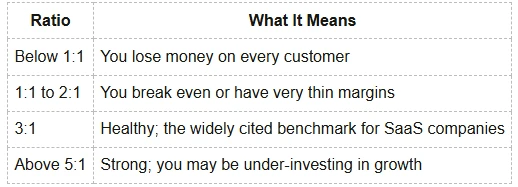
A ratio of 3:1 is the standard benchmark in venture-backed SaaS, popularized by David Skok and widely accepted across the startup ecosystem.
Contribution Margin Per Unit
Contribution margin per unit is the revenue left over after subtracting variable costs from each unit sold. It shows how much each unit "contributes" toward covering fixed costs and generating profit.
Formula:
Contribution Margin = Revenue Per Unit − Variable Cost Per Unit
If you sell a product for $80 and it costs $30 to produce and ship, your contribution margin is $50 per unit.
4. How to Calculate Unit Economics Step by Step
Follow this process to calculate unit economics for your business.
Step 1: Define your unit. Choose whether your unit is a customer, a subscription, a transaction, or a product. Be consistent.
Step 2: Calculate your CAC. Add up all sales and marketing costs for a specific period. Divide by the number of new customers acquired in that same period.
Step 3: Calculate your LTV. Estimate average revenue per customer and average customer lifespan. Multiply them together. For more accuracy, subtract the cost to serve that customer (gross margin-adjusted LTV).
Step 4: Calculate your LTV:CAC ratio. Divide LTV by CAC. Compare against the benchmarks in the table above.
Step 5: Calculate your contribution margin. Subtract all variable costs per unit from your per-unit revenue.
Step 6: Calculate your CAC payback period. This tells you how many months it takes to recover what you spent acquiring a customer.
CAC Payback Period = CAC ÷ Monthly Gross Profit Per Customer
A payback period under 12 months is generally healthy for most businesses. Below 6 months is excellent.
5. Real-World Examples
Example 1: A DTC E-Commerce Brand
A direct-to-consumer skincare brand spends $200,000 per month on paid ads and acquires 4,000 new customers. That gives them a CAC of $50.
Their average customer buys twice per year at an average order value of $65, and stays loyal for about 3 years.
- LTV = $65 × 2 × 3 = $390
- LTV:CAC Ratio = $390 ÷ $50 = 7.8:1
This is an excellent ratio. The brand has strong economics and can confidently invest more in customer acquisition.
Example 2: A B2B SaaS Startup
A project management tool charges $120 per month per seat. Their average customer churns after 18 months.
- LTV = $120 × 18 = $2,160
- CAC (sales team + ads) = $900
- LTV:CAC Ratio = $2,160 ÷ $900 = 2.4:1
This is below the 3:1 benchmark. The startup needs to either reduce CAC through more efficient acquisition channels or improve retention to increase average customer lifetime.
Example 3: A Food Delivery Startup
A food delivery platform spends $30 to acquire each new user. The average user places 8 orders per year at a commission of $4 per order, and stays active for 2 years.
- LTV = $4 × 8 × 2 = $64
- LTV:CAC Ratio = $64 ÷ $30 = 2.1:1
The math is weak, and the CAC payback period is long. Without improving retention or increasing order frequency, scaling this model burns capital fast.
6. SaaS Unit Economics: A Special Case
SaaS unit economics follow the same framework but deserve extra attention because of the recurring revenue model and the weight of churn.
In SaaS, two additional metrics matter heavily.
Churn Rate: The percentage of customers who cancel their subscription in a given period. Even a 2% monthly churn rate compounds to roughly 22% annual churn, which dramatically shrinks LTV.
Gross Margin-Adjusted LTV: Standard LTV uses revenue. But in SaaS, you also have infrastructure costs, customer support, and hosting that reduce actual value. A more accurate formula is:
LTV = (ARPU × Gross Margin %) ÷ Monthly Churn Rate
If ARPU is $100, gross margin is 75%, and monthly churn is 2%:
LTV = ($100 × 0.75) ÷ 0.02 = $3,750
SaaS companies with a 3:1 LTV:CAC ratio and a CAC payback period under 12 months are generally considered healthy by investors.
7. Unit Economics vs. Overall Profitability: What Is the Difference?
These two concepts are related but not the same.
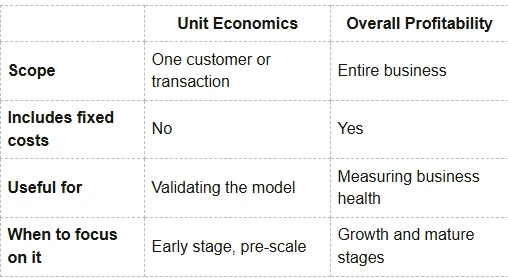
A business can have strong unit economics but still be unprofitable overall because of high fixed costs like office space, engineering salaries, or debt. Equally, a business can appear profitable at the company level while quietly losing money on every single customer, masked by volume.
Unit economics and overall profitability must be read together.
8. Common Mistakes Founders Make
Ignoring CAC payback period. A great LTV:CAC ratio means nothing if it takes 36 months to recoup your acquisition cost. Cash flow matters.
Using blended CAC. Averaging acquisition costs across all channels hides which channels are efficient and which are destroying margin. Always break CAC down by channel.
Not adjusting LTV for gross margin. Using raw revenue instead of margin-adjusted revenue overstates LTV and gives a falsely optimistic picture.
Counting all customers equally. Different customer segments often have very different LTVs. Cohort analysis helps you understand which segments have the best economics.
Scaling before unit economics are positive. The most common and most expensive mistake. If CAC exceeds LTV, growth accelerates losses.
FAQ
What is the unit economics definition in simple terms? Unit economics is the profit or loss your business makes from one customer or one transaction. It answers the question: does one unit of your business make money?
What is a good LTV to CAC ratio? A ratio of 3:1 is the widely accepted benchmark, especially in SaaS. It means you generate three times the revenue from a customer compared to what you spent acquiring them. Below 1:1 means you lose money on every customer.
How is unit economics used by startups? Startups use unit economics to validate their business model before scaling. If the economics are positive, investors and founders can be confident that growth will compound returns rather than losses.
What is the difference between CAC and Customer Acquisition Cost? They are the same metric. CAC stands for Customer Acquisition Cost, the total spend divided by the number of new customers acquired in a given period.
How does churn affect SaaS unit economics? Churn directly shortens customer lifetime, which reduces LTV. Even a small increase in monthly churn can significantly reduce LTV and flip a healthy LTV:CAC ratio into an unprofitable one.
What is contribution margin per unit and why does it matter? Contribution margin per unit is the revenue remaining after subtracting variable costs. It shows how much each unit sold contributes to covering fixed costs. If this number is negative, your pricing cannot sustain the business regardless of volume.
Conclusion
Unit economics is not a complex concept reserved for financial analysts. It is the clearest lens through which any founder, growth manager, or business student can understand whether a business model actually works.
At its core, unit economics tells you one thing: are you building a machine that creates value with every customer, or one that quietly destroys it?
By mastering metrics like CAC, LTV, the LTV:CAC ratio, and contribution margin per unit, you move from hoping your business is profitable to knowing it is. That confidence is what separates businesses that scale sustainably from those that burn out trying.
Start with one unit. Understand it deeply. Then decide whether it is worth building a thousand more.