Every business reaches a point where the numbers demand a tough conversation. Revenue looks fine on paper, but margins are quietly shrinking. Overhead keeps climbing. And someone in the room says the words every team dreads: "We need to cut costs."
Here is the problem with how most businesses respond to that moment. They slash budgets reactively, cut headcount impulsively, and reduce quality in ways that quietly push customers out the door. Six months later, they are worse off than before.
Business cost reduction strategies, when done right, are not about panic cuts. They are about building a leaner, smarter operation that delivers the same, or better, value at a lower cost. That is the difference between surviving a rough quarter and building a business that consistently outperforms competitors.
This guide walks you through a proven, strategic framework for reducing costs without losing what makes your business worth choosing.
Quick Answer
What are the best business cost reduction strategies?
The most effective business cost reduction strategies include:
- Auditing current spending to identify waste
- Automating repetitive processes
- Renegotiating vendor and supplier contracts
- Outsourcing non-core business activities
- Improving operational efficiency through lean management
- Optimizing your supply chain
- Investing in employee productivity tools
These are not one-time fixes. They are ongoing practices that compound over time.
Table of Contents
- Cost Optimization vs. Cost-Cutting
- Step-by-Step Framework for Reducing Business Costs
- Real-World Examples of Smart Cost Reduction
- Operational Efficiency Techniques That Protect Quality
- Process Automation for Cost Savings
- Vendor Negotiation Tactics That Actually Work
- Outsourcing Non-Core Activities: What to Hand Off
- Optimizing Supply Chain Costs
- Comparison: Reactive Cost-Cutting vs. Strategic Cost Optimization
- FAQ
- Conclusion
1. Cost Optimization vs. Cost-Cutting: Know the Difference
Before you touch a single budget line, you need to understand what you are actually trying to do.
Cost-cutting is reactive. It means reducing spending immediately, often without a long-term plan. It can work in a short-term crisis, but it frequently damages the business in the process.
Cost optimization is strategic. It means finding ways to deliver the same or greater value at a lower cost. It protects quality, improves efficiency, and strengthens your competitive position over time.
Definition Box: Cost optimization is the ongoing process of identifying and eliminating inefficiencies in business operations while maintaining or improving output quality and customer value.
Most businesses that struggle after "cutting costs" made one critical mistake: they chose cost-cutting when they needed cost optimization. The rest of this guide is about the smarter path.
2. Step-by-Step Framework for Reducing Business Costs
Follow these steps in order. Skipping steps is how businesses create new problems while solving old ones.
Step 1: Conduct a Full Spending Audit
Pull every expense for the last 12 months. Categorize them by department, function, and necessity. You are looking for three things: redundant tools, underutilized services, and processes that cost more than the value they produce.
Most businesses find 10 to 20 percent of their spend falls into at least one of these categories on the first pass.
Step 2: Prioritize by Impact and Risk
Not every cost is equal. Some expenses are directly tied to revenue generation or product quality. Others are administrative or legacy spending that no one has reviewed in years.
Create a simple matrix: high impact savings versus low risk to quality. Start there.
Step 3: Set Clear Cost Reduction Targets
Vague goals produce vague results. Set a specific target, such as reducing operational overhead by 15 percent over six months, without reducing output capacity.
Step 4: Involve Your Team
The people doing the work know where the waste is. Frontline employees and managers often see inefficiencies that leadership cannot see from above. Create a simple process for them to flag waste without fear.
Step 5: Implement, Measure, and Adjust
Every cost reduction initiative needs a metric. Track it monthly. If a change is hurting quality or output, catch it early and adjust before it becomes a bigger problem.
Step 6: Reinvest Savings Strategically
This is the step most businesses skip. When you free up capital through cost reduction, deploy it deliberately. Reinvest in areas that drive growth, improve customer experience, or build competitive advantage.
3. Real-World Examples of Smart Cost Reduction
Toyota and Lean Manufacturing
Toyota did not become the world's most efficient automaker by slashing budgets. They built the Toyota Production System, a lean business management framework that eliminates waste at every stage of production. Their concept of "muda" (waste) covers overproduction, waiting time, unnecessary motion, and defects. The result is a system that produces high-quality vehicles at lower operational cost than most competitors.
Slack and Internal Communication Costs
Before Slack was a product, the team behind it was a gaming startup called Glitch. They were burning money on inefficient internal communication. They built Slack as an internal tool to fix their own workflow. When they realized it worked extraordinarily well, they launched it as a product. The cost-saving insight became a billion-dollar business.
Small Business Example: A Regional Restaurant Chain
A restaurant group with eight locations was spending heavily on food waste and inconsistent supplier pricing. They standardized their menu across locations, renegotiated a unified supplier contract for higher volume pricing, and implemented a weekly inventory review process. Over 12 months, food costs dropped by 18 percent and quality consistency across locations actually improved.
These examples share a common thread: the savings came from smarter systems, not from reducing what customers actually receive.
4. Operational Efficiency Techniques That Protect Quality
Operational efficiency techniques are at the core of every successful cost reduction strategy. The goal is to produce the same output with fewer inputs, not to produce less.
Lean Business Management
Lean principles, originally from manufacturing, apply to almost every industry. The core idea is simple: identify every step in a process and ask whether it adds value. If it does not, eliminate or reduce it.
For service businesses, this might mean streamlining a client onboarding process from 12 steps to 7. For product businesses, it might mean reducing the number of approval layers in a production workflow.
Standard Operating Procedures (SOPs)
Inconsistency is expensive. When tasks are done differently by different people each time, mistakes happen, rework accumulates, and time is wasted. SOPs bring consistency, which reduces error rates and the cost of fixing them.
Time Tracking and Workflow Analysis
You cannot optimize what you cannot measure. Simple time tracking tools reveal where hours are being spent versus where they should be spent. Many businesses discover that high-cost employees are spending significant time on low-value tasks that could be delegated or automated.
5. Process Automation for Cost Savings
Process automation for cost savings is one of the highest-leverage strategies available to modern businesses. The cost of automation tools has dropped dramatically in the last decade, making this accessible to businesses of every size.
What to Automate First
Focus on tasks that are:
- Repetitive and rule-based
- High-volume
- Low in judgment requirements
- Currently done manually by skilled (and expensive) staff
High-ROI Automation Examples
- Invoicing and accounts payable: Tools like QuickBooks or Xero automate invoice generation, payment reminders, and reconciliation.
- Customer support: AI chatbots handle tier-one support queries, reducing the volume of tickets that reach human agents.
- Email marketing: Automated sequences replace manual follow-up work.
- Inventory management: Automated reorder triggers prevent both stockouts and overstock situations.
- Payroll processing: Automated payroll systems reduce errors and the administrative time spent on compliance.
A McKinsey study found that approximately 45 percent of work activities could be automated using existing technology. That represents a significant opportunity for most businesses to reduce labor costs without reducing headcount in areas that directly affect quality or growth.
6. Vendor Negotiation Tactics That Actually Work
Vendor negotiation tactics are consistently underutilized by small and mid-sized businesses. Most vendors expect negotiation. Most businesses simply do not do it.
Tactic 1: Consolidate Vendor Relationships
Buying more from fewer vendors gives you leverage. Instead of spreading spend across five suppliers, consolidate with two or three. Then negotiate volume-based pricing. Vendors will almost always offer better terms to protect a larger account.
Tactic 2: Use Competitive Bids Transparently
Get quotes from multiple vendors and be transparent with your primary vendor about it. You do not need to be aggressive. Simply saying "We are reviewing our vendor relationships and comparing pricing" opens most doors.
Tactic 3: Offer Something in Return
Vendors are more willing to reduce pricing when they get something valuable in exchange. Longer contract terms, early payment terms, or a testimonial and referral can all move the conversation forward.
Tactic 4: Review Contracts Annually
Most businesses sign a vendor contract and forget it. Prices change, market rates shift, and your usage patterns evolve. An annual contract review is often the easiest way to find immediate savings.
Tactic 5: Pay Early When the Math Works
Many vendors offer a 2 to 3 percent discount for early payment. On large invoices, that adds up quickly and costs you nothing except cash flow timing.
7. Outsourcing Non-Core Activities: What to Hand Off
Outsourcing non-core activities is one of the fastest ways to reduce overhead without sacrificing quality. The key is knowing which activities are core to your competitive advantage and which are simply necessary functions.
What to Consider Outsourcing
- IT support and infrastructure management
- Bookkeeping and accounting
- Legal and compliance functions
- Digital marketing and content production
- HR administration and payroll
- Customer service (tier-one and overflow)
- Logistics and fulfilment
What to Keep In-House
Keep anything that is central to your unique value proposition. If your product quality depends on a proprietary process, that stays internal. If your customer relationships are a key differentiator, the people managing those relationships should be core team members.
Outsourcing works best when the task is clearly defined, quality standards can be measured, and the function does not require deep knowledge of your business culture or strategy.
8. Optimizing Supply Chain Costs
Optimizing supply chain costs can produce significant savings without any visible impact on the customer. This is particularly relevant for product businesses, but service businesses with physical inputs benefit equally.
Strategies for Supply Chain Optimization
- Demand forecasting: Better data-driven forecasting reduces both overstock and emergency procurement costs.
- Supplier diversification: Relying on a single supplier creates price risk. Having two to three qualified suppliers creates competitive tension that keeps pricing reasonable.
- Local vs. global sourcing: In some categories, local sourcing reduces shipping time and cost. Run the full cost comparison including lead time, shipping, and risk before defaulting to the cheapest unit price.
- Inventory turnover improvement: Slow-moving inventory ties up capital and creates storage costs. Identify your lowest-turnover SKUs and address them through pricing adjustments, bundling, or supplier return agreements.
9. Comparison: Reactive Cost-Cutting vs. Strategic Cost Optimization
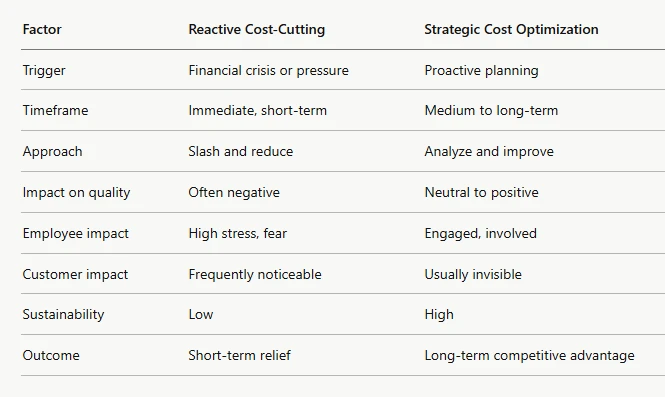
The businesses that outperform their competitors in cost efficiency almost always operate from the right column of this table. They build systems and habits that continuously improve, rather than waiting for a crisis to force their hand.
10. FAQ: Business Cost Reduction Strategies
Q1: What is the most effective business cost reduction strategy?
There is no single "most effective" strategy because businesses differ. However, process automation and operational efficiency improvements consistently produce the highest return across industries. Start with a spending audit, identify your highest-cost processes, and look for automation or streamlining opportunities before cutting anything else.
Q2: How do you reduce costs without affecting quality?
Focus on eliminating waste rather than reducing output. Lean management principles, SOPs, vendor renegotiation, and automation reduce cost inputs without reducing what the customer receives. The distinction matters: cut inefficiency, not value.
Q3: What is the difference between cost optimization and cost reduction?
Cost reduction simply means spending less. Cost optimization means spending more efficiently to achieve the same or better outcomes. Optimization is the broader, more strategic goal. Reduction is one tool within it.
Q4: When should a business outsource to reduce costs?
Outsource when a function is non-core, clearly defined, measurable, and can be performed at equivalent or higher quality by a specialist provider for less than it costs to maintain internally. Common examples include IT, accounting, HR administration, and customer support.
Q5: How can small businesses reduce overhead without sacrificing quality?
Small businesses benefit most from consolidating vendor relationships, adopting cloud-based tools that replace expensive software, automating administrative tasks, and reviewing subscriptions and services annually. These steps are low-risk, quick to implement, and do not affect what customers experience.
Q6: How long does it take to see results from cost reduction strategies?
Quick wins like vendor renegotiation and subscription audits can show results within 30 to 90 days. Structural improvements like process automation and lean management typically take 3 to 12 months to fully realize. The compounding benefit of strategic cost optimization builds over years.
Conclusion
Reducing costs is not about being cheap. It is about being smart with the resources you already have.
The businesses that sustain long-term profitability do not achieve it through aggressive cuts. They build cultures of operational discipline where every process is reviewed, every vendor relationship is managed, and every dollar is expected to earn its place. That is the essence of strategic business cost reduction strategies.
Start with a thorough spending audit. Involve your team. Automate what can be automated. Negotiate what can be negotiated. And always ask the most important question before making any change: does this reduce waste, or does it reduce value?
If it reduces waste, do it. If it reduces value, find another way.
The strategies in this guide are not theoretical. They are the same approaches that lean, profitable businesses use consistently to grow margins without compromising the quality that keeps their customers coming back.
Pick one strategy. Start this week. Build from there.