Most small businesses don't fail because of bad products. They fail because the numbers never made sense from the start.
If you've ever looked at your bank account and wondered where the revenue went, you're not alone. The gap between making money and keeping money almost always comes down to one thing: a missing cost structure and profit plan.
Business cost structure and profit planning is the financial backbone of every sustainable business. It tells you what you spend, what you earn, and whether your model can actually survive long-term. Without it, you're essentially flying blind with a full tank of hope and an empty map.
This guide gives you a practical, step-by-step framework to build yours from scratch, even if you've never touched a financial model before.
Quick Answer
What is a business cost structure? A business cost structure is a breakdown of all the costs a company incurs to operate and deliver its product or service. It categorizes expenses into fixed costs, variable costs, and semi-variable costs to help business owners understand spending patterns and identify paths to profitability.
What is profit planning? Profit planning is the process of setting financial targets, forecasting revenue, and aligning your cost structure to ensure your business generates sustainable margins over time.
Table of Contents
- What Is a Business Cost Structure?
- Types of Business Costs You Must Know
- How to Build Your Cost Structure (Step-by-Step)
- How to Create a Profit Plan
- Real-World Cost Structure Examples
- Operating Expenses vs Capital Expenditures
- Sustainable Profit Margin Strategies
- Tools for Financial Forecasting
- Cost Structure Comparison Table
- FAQ
- Conclusion
1. What Is a Business Cost Structure?
A cost structure is simply a map of where your money goes. It captures every expense required to run your business, from the rent you pay every month to the ad spend that fluctuates with your campaigns.
Understanding your cost structure isn't just an accounting exercise. It's a strategic tool. When you know your costs deeply, you can price confidently, cut waste intelligently, and forecast profitability with accuracy.
The concept comes from the Business Model Canvas, developed by Alexander Osterwalder, where "Cost Structure" is one of the nine core building blocks. For small business owners and solopreneurs, it's the block most people skip, and it's the one that costs them the most.
2. Types of Business Costs You Must Know
Before you can build a cost structure, you need to understand the three primary cost categories.
Fixed Costs
These costs don't change regardless of how much you sell.
- Office rent or co-working memberships
- Salaries for full-time employees
- Software subscriptions (CRM, accounting tools, hosting)
- Insurance premiums
- Loan repayments
Example: You pay $1,200/month for your project management software whether you have 10 clients or 100.
Variable Costs
These costs scale up or down with your output or sales volume.
- Raw materials and inventory
- Freelancer or contractor fees
- Payment processing fees (Stripe, PayPal)
- Packaging and shipping
- Per-click advertising spend
Example: If you sell 500 units, your packaging cost is 5x higher than if you sell 100 units.
Semi-Variable Costs
These have a fixed base but a variable component layered on top.
- Utility bills (base charge + usage)
- Sales commissions (base salary + performance bonus)
- Customer support staffing (core team + surge contractors)
Most businesses have a blend of all three. The goal is to understand the ratio, because a business with high fixed costs needs strong, consistent revenue to stay solvent.
3. How to Build Your Cost Structure (Step-by-Step)
Here is a straightforward process to build your cost structure from scratch.
Step 1: List Every Current Expense
Open your bank statements and business credit card records for the last three months. Write down every single line item. Don't skip anything, including the $9/month Canva subscription.
Organize them into three columns: Fixed, Variable, and Semi-Variable.
Step 2: Calculate Your Monthly Cost Baseline
Add up all your fixed costs. This is your monthly burn floor, the minimum you spend even if you make zero sales.
Formula:
Monthly Burn Floor = Total Fixed Costs + Minimum Semi-Variable Costs
If your burn floor is $4,000/month and you're not hitting that in net revenue, you are losing money every single day.
Step 3: Identify Your Cost Drivers
Cost drivers are the activities or metrics that cause your costs to increase. For an e-commerce store, the cost driver might be order volume. For a SaaS business, it could be server usage per active user.
Identifying cost drivers helps you predict how costs will scale as your business grows.
Step 4: Map Costs to Revenue Streams
Assign each major cost to a specific product, service, or revenue stream. This is called cost allocation and it reveals which parts of your business are profitable and which are draining resources.
This step alone can completely change your strategy. Many entrepreneurs discover that 80% of their costs are supporting a product line generating only 20% of revenue.
Step 5: Calculate Your Break-Even Point
Your break-even point is the revenue level where total costs equal total revenue. You're not profitable yet, but you're not losing money either.
Formula:
Break-Even Point = Fixed Costs ÷ (Selling Price per Unit – Variable Cost per Unit)
Example: If your fixed costs are $5,000/month, you sell a service at $500, and your variable cost per delivery is $100:
Break-Even = $5,000 ÷ ($500 – $100) = 12.5 clients per month
You need 13 clients just to break even. Now you have a real target.
4. How to Create a Profit Plan
A profit plan is your financial roadmap. It connects your cost structure to your revenue goals and gives you a clear target to hit each quarter.
Step 1: Set a Net Profit Target
Decide what profit you want to generate. Be specific. "I want to make more money" is not a plan. "I want to generate $3,500 in net profit per month by Q4" is.
Step 2: Work Backwards from Your Revenue Goal
Use this formula:
Required Revenue = Total Costs + Target Net Profit
If your total monthly costs are $6,000 and your profit target is $3,500:
Required Revenue = $6,000 + $3,500 = $9,500/month
Step 3: Build a Revenue Forecast
Break your revenue target into specific streams. If you offer consulting, a digital product, and a retainer service, forecast each one separately.
Use a profit and loss planning template (available in tools like Google Sheets, Wave, or QuickBooks) to model three scenarios:

Step 4: Monitor Monthly and Adjust Quarterly
A profit plan is not a set-it-and-forget-it document. Review your actual vs. projected numbers every month. Adjust your plan every quarter based on real data.
5. Real-World Cost Structure Examples
Example 1: Freelance Designer (Solopreneur)

Break-even at $500/project: 1 project covers fixed costs. Profit scales cleanly with each additional project.
Example 2: E-Commerce Brand (Small Business)
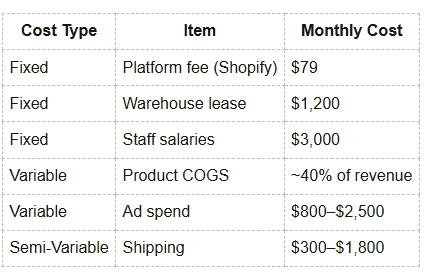
This business has a high fixed cost floor ($4,279) before any product is sold. It needs strong, consistent volume to stay profitable. Margin management is critical here.
6. Operating Expenses vs Capital Expenditures
This distinction matters more than most entrepreneurs realize.
Operating Expenses (OpEx) are the day-to-day costs of running your business. They are fully deductible in the year they occur.
- Salaries, rent, utilities, software subscriptions, marketing
Capital Expenditures (CapEx) are investments in long-term assets. They are depreciated over time, not deducted all at once.
- Equipment purchases, machinery, office buildouts, vehicles
Why it matters for profit planning: CapEx improves your infrastructure but doesn't reduce taxes as fast as OpEx. A solopreneur buying a $5,000 laptop cannot deduct the entire amount immediately in most jurisdictions (though Section 179 in the US allows immediate expensing in some cases). Understanding this distinction prevents nasty surprises at tax time.
7. Sustainable Profit Margin Strategies
A one-time profitable month means nothing. The goal is sustainable margins. Here are proven strategies:
1. Reduce COGS without sacrificing quality Negotiate supplier contracts annually. Consolidate vendors. Buy in bulk when cash flow allows.
2. Increase revenue per customer Upsell, cross-sell, and create bundled offers. Acquiring a new customer costs 5x more than retaining one (Harvard Business Review data).
3. Automate variable labor costs Use tools like Zapier, Make (formerly Integromat), or AI tools to reduce manual work that scales with volume.
4. Price for value, not time Service businesses that bill hourly hit a hard ceiling. Value-based pricing removes that ceiling and improves margins dramatically.
5. Set a margin floor Never let net profit margins fall below 15–20% for service businesses or 10% for product businesses. If a client or product line can't meet that threshold, renegotiate or cut it.
8. Cost Structure Comparison: Cost-Driven vs Value-Driven Models
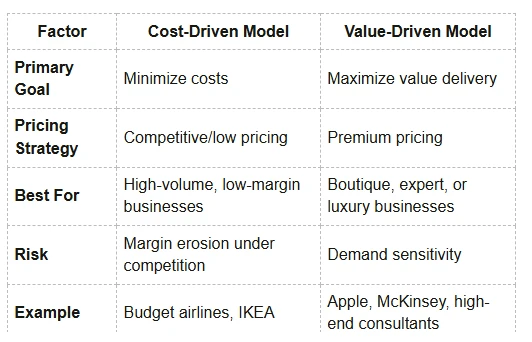
Most small businesses and solopreneurs benefit more from a value-driven model because competing on cost against large operators is nearly impossible without economies of scale.
10. Frequently Asked Questions
Q1: What is the difference between a cost structure and a budget? A budget is a short-term financial plan that sets spending limits for a period. A cost structure is a strategic breakdown of how a business categorizes and manages all its costs as a permanent part of its business model.
Q2: How do I do a cost-benefit analysis for a startup? List all anticipated costs (one-time and recurring) against the expected financial and non-financial benefits of a decision. If quantified benefits exceed total costs within an acceptable time frame, the investment is justified. Tools like Excel or Google Sheets work well for this.
Q3: What is a good profit margin for a small business? It varies by industry. Generally, a net profit margin of 10–20% is healthy for most small businesses. Service-based businesses can target 20–40% net margins. Product businesses typically see 5–15%.
Q4: How often should I update my profit plan? Review actual vs. projected numbers monthly. Do a full plan revision quarterly. Annual strategic overhauls should factor in market changes, new products, and growth targets.
Q5: What's the best profit and loss planning template for beginners? Google Sheets offers free P&L templates through its template gallery. SCORE (the US small business mentoring organization) also provides free downloadable financial planning templates suited for early-stage businesses.
Q6: What are the biggest cost structure mistakes small business owners make? The most common mistakes include: underestimating variable costs at scale, ignoring semi-variable costs in forecasting, failing to allocate costs to specific revenue streams, and not setting a break-even target before launch.
Conclusion
Building a solid business cost structure and profit plan isn't just financial housekeeping. It's the difference between a business that grows with intention and one that survives by luck.
Here's what you've learned:
- How to categorize fixed, variable, and semi-variable costs
- How to calculate your break-even point and monthly burn floor
- A step-by-step process to build a profit plan with real revenue targets
- The difference between operating expenses and capital expenditures
- Proven strategies for sustainable profit margins
- Tools that make financial forecasting accessible for non-accountants
Start with one action today: pull your last three months of business expenses and sort them into the three cost categories. That single exercise will show you more about your business's financial health than any dashboard or report.
Your profit plan starts with knowing where every dollar goes. Now you know how to find out.