You work hard every single day. But at the end of the month, do you actually know how much money your business is keeping?
Most small business owners track revenue. Very few track profit margin. And that gap is exactly why so many businesses stay stuck, or quietly fail, despite growing sales.
The profit margin formula is one of the most powerful tools in business. It tells you not just how much money you made, but how efficiently your business actually runs. Whether you sell products, offer services, or run an online store, understanding profit margins will change how you make decisions.
This guide breaks everything down in plain language. No finance degree required.
Quick Answer: What Is the Profit Margin Formula?
The basic profit margin formula is:
Profit Margin = (Net Profit ÷ Revenue) × 100
This gives you a percentage that shows how much of every dollar in sales your business actually keeps as profit. For example, a 20% profit margin means you keep $0.20 for every $1.00 earned.
Table of Contents
- What Is Profit Margin?
- The Profit Margin Formula Explained
- Types of Profit Margin (Gross, Operating, Net)
- How to Calculate Profit Margin: Step by Step
- Gross Profit Margin vs Net Profit Margin
- Average Profit Margin for Small Business
- Profit Margin for Service Business
- Markup vs Margin: What Is the Difference?
- Real-World Examples
- How to Improve Your Profit Margins
- FAQ
1. What Is Profit Margin?
Profit margin is a financial ratio that measures how much profit a business earns relative to its revenue. It is expressed as a percentage.
Think of it this way: if your business earns $100,000 in revenue and your profit is $20,000, your profit margin is 20%. That means for every dollar you bring in, you keep 20 cents.
It answers one of the most important questions in business: "Is this actually worth it?"
High revenue does not always mean high profit. A business making $500,000 in sales but spending $490,000 to run has a very thin margin and is one bad month away from trouble.
2. The Profit Margin Formula Explained
There are three versions of the profit margin formula, and each one tells you something different about your business.
Margin Type Formula Gross Profit Margin (Gross Profit ÷ Revenue) × 100 Operating Profit Margin (Operating Profit ÷ Revenue) × 100 Net Profit Margin (Net Profit ÷ Revenue) × 100
Each formula uses "profit" differently, so let's define the key terms first.
Revenue: The total amount of money your business earns from sales before any expenses are deducted.
Gross Profit: Revenue minus the direct cost of producing your goods or services (also called Cost of Goods Sold, or COGS).
Operating Profit: Gross profit minus operating expenses like rent, salaries, and utilities.
Net Profit: What is left after ALL expenses, including taxes and interest, are deducted from revenue. This is your "bottom line."
3. Types of Profit Margin
Gross Profit Margin
This shows how efficiently you produce or deliver your product or service.
Formula: (Revenue – COGS) ÷ Revenue × 100
Example: If you earn $80,000 in revenue and your COGS is $50,000, your gross profit is $30,000. Divide by $80,000 and multiply by 100. Your gross profit margin is 37.5%.
Operating Profit Margin Formula
This adds in your overhead costs like rent, payroll, and software subscriptions.
Formula: Operating Profit ÷ Revenue × 100
Example: Using the same $30,000 gross profit from above, if your operating expenses are $15,000, your operating profit is $15,000. Divided by $80,000 revenue, your operating profit margin is 18.75%.
Net Profit Margin Percentage
This is the most complete picture of profitability. It includes everything: taxes, loan interest, and all other expenses.
Formula: Net Profit ÷ Revenue × 100
Example: If after taxes and interest your business keeps $10,000 from $80,000 in revenue, your net profit margin is 12.5%.
4. How to Calculate Profit Margin: Step by Step
Learning how to calculate profit margin is easier than it sounds. Follow these steps for any type of margin.
Step 1: Find your revenue for the period (month, quarter, or year).
Step 2: Subtract the appropriate costs.
- For gross margin: subtract only COGS
- For operating margin: subtract COGS plus operating expenses
- For net margin: subtract all expenses including taxes and interest
Step 3: Divide the result by your total revenue.
Step 4: Multiply by 100 to convert to a percentage.
That is it. Four steps. You can do this in a spreadsheet, a calculator, or even on paper.
5. Gross Profit Margin vs Net Profit Margin
Many business owners confuse these two. Here is the clearest way to understand them.
Gross profit margin only looks at production costs. It ignores rent, admin salaries, marketing, and taxes. It is useful for evaluating whether your core product or service is profitable.
Net profit margin is the real deal. It tells you how much money you actually keep after paying for everything. This is the number investors, lenders, and accountants care about most.
Key rule: You can have a high gross margin and still lose money if your overhead is too high.
A software company might have a 75% gross margin (since code is cheap to distribute) but a 10% net margin after accounting for developer salaries, server costs, and marketing.
A restaurant might have a 60% gross margin on food but only a 3–5% net margin after paying chefs, servers, rent, and utilities.
6. Average Profit Margin for Small Business
What is a good profit margin? The answer depends on your industry.
Here are average profit margin benchmarks to use as a reference:
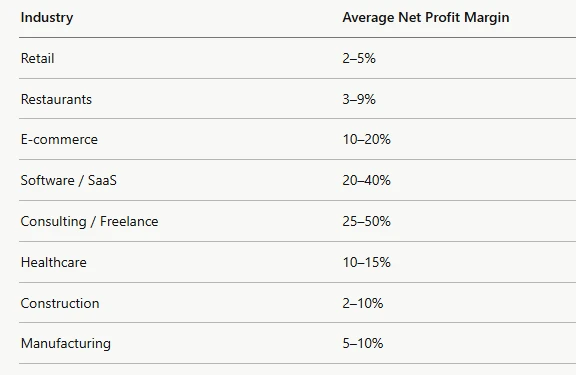
These are averages. Your specific margins will depend on your pricing, location, cost structure, and business model.
As a general rule:
- Below 5%: Thin and risky
- 10–20%: Healthy
- Above 20%: Excellent (especially for service businesses)
7. Profit Margin for Service Business
If you run a service business such as a marketing agency, law firm, cleaning company, or freelance operation, your margin calculations look a bit different.
Service businesses often do not have traditional COGS. Your main costs are labor (including your own time), tools, and overhead.
For service businesses, gross margin is calculated as: Revenue – Labor Costs ÷ Revenue × 100
A freelance web designer who charges $5,000 per project and spends 40 hours on it at an effective hourly cost of $25 per hour has labor costs of $1,000.
Gross profit: $4,000. Gross margin: 80%.
After accounting for software subscriptions, advertising, and other overhead, net margin might be 40–60%. Service businesses typically enjoy higher margins than product businesses because there is no physical inventory or manufacturing cost.
If you run a service business and your net margin is below 20%, it is worth reviewing your pricing or the efficiency of how you deliver work.
8. Markup vs Margin: What Is the Difference?
This is one of the most common confusions in small business finance. Markup and margin are not the same thing, even though they both involve profit.
Margin is calculated based on the selling price.
Markup is calculated based on the cost.
Margin formula: (Selling Price – Cost) ÷ Selling Price × 100
Markup formula: (Selling Price – Cost) ÷ Cost × 100
Example: You buy a product for $40 and sell it for $60.
- Profit: $20
- Margin: $20 ÷ $60 × 100 = 33.3%
- Markup: $20 ÷ $40 × 100 = 50%
Same numbers, different percentages. Many business owners accidentally quote markup when they mean margin, which leads to underpricing.
9. Real-World Examples
Example 1: A Clothing Boutique
A clothing store earns $200,000 in annual revenue. The cost of purchasing inventory is $110,000. Operating expenses (rent, staff, utilities) total $55,000. After taxes, net profit is $25,000.
- Gross Margin: ($200K – $110K) ÷ $200K × 100 = 45%
- Net Margin: $25K ÷ $200K × 100 = 12.5%
The gross margin looks healthy, but high operating costs eat into the bottom line.
Example 2: A Digital Marketing Agency
A small agency bills $300,000 per year. Contractor costs are $90,000. Software, office, and advertising expenses total $60,000. Net profit after taxes: $120,000.
- Gross Margin: ($300K – $90K) ÷ $300K × 100 = 70%
- Net Margin: $120K ÷ $300K × 100 = 40%
This is a high-margin service business. Lower overhead and no physical inventory create strong profitability.
10. How to Improve Your Profit Margins
Knowing your margins is only the first step. The goal is to improve them over time.
Here are proven strategies:
1. Raise Your Prices: Most small business owners underprice. A 10% price increase on every product or service can dramatically lift margins, especially if your volume stays stable.
2. Reduce Cost of Goods Sold: Negotiate with suppliers, buy in bulk, find alternatives, or streamline your production process.
3. Cut Unnecessary Overhead: Review all fixed and variable expenses quarterly. Subscriptions, inefficient processes, and underused tools add up fast.
4. Upsell and Cross-Sell: Selling more to existing customers costs far less than acquiring new ones. Higher average order value with the same overhead equals better margins.
5. Focus on High-Margin Products or Services: Not everything you sell is equally profitable. Identify your highest-margin offerings and put more energy into promoting them.
6. Automate Repetitive Tasks: Time is money, especially in service businesses. Tools that automate scheduling, invoicing, and customer communication reduce labor costs and free you up for high-value work.
FAQ: Profit Margin Formula
Q: What is the easiest profit margin formula to use? The simplest version is: Profit Margin = (Net Profit ÷ Revenue) × 100. Start here if you are just getting started.
Q: What is a good profit margin for a small business? Most experts consider 10–20% a healthy net profit margin for small businesses. Service businesses often achieve 25–50%, while retail may settle at 5–10%.
Q: How is profit margin different from profit? Profit is a dollar amount (example: $10,000). Profit margin is a percentage that shows profit relative to revenue (example: 10%). Margin is more useful for comparing performance over time or against competitors.
Q: Can a business with high revenue have a low profit margin? Absolutely. High revenue does not guarantee profitability. If expenses grow as fast as revenue, margins stay thin. This is why revenue alone is a misleading metric.
Q: What is the difference between gross and net profit margin? Gross margin only subtracts production costs. Net margin subtracts all costs including overhead, interest, and taxes. Net margin gives the most complete picture of business health.
Q: How often should I calculate my profit margin? At minimum, calculate it monthly. Many business owners do it weekly. The more often you check, the faster you can spot problems and respond.
Conclusion
Understanding the profit margin formula is one of the highest-leverage things you can do as a business owner. It moves you from guessing to knowing. From reacting to planning.
To recap the key points:
- Profit margin = (Profit ÷ Revenue) × 100
- There are three types: gross, operating, and net
- Gross margin shows production efficiency; net margin shows true profitability
- Average margins vary widely by industry
- Service businesses typically enjoy higher margins than product businesses
- Markup and margin are not the same thing
- You can improve margins by raising prices, cutting costs, and focusing on high-margin offers
Start by calculating your net profit margin for last month. That one number will tell you more about your business than a dozen revenue reports.
Once you know where you stand, you can start making smarter decisions that build a business that is not just busy, but genuinely profitable.